

If you just extend the trends of the last four years, you reach broadly human-level “digital worker” AGI in 2-4 years, and superhuman AI soon after.
This isn’t guaranteed. It could take a couple of years longer, or even decades.
I’ve written a separate 10,000 word article about this topic. But here I want to emphasise one key point: near-term superintelligence wouldn’t break the existing trend. So we need to take it very, very seriously.
For over ten years, AI has overcome limitation after limitation, and kept advancing much faster than expected. Now the burden of proof is not to show the progress of AI will continue, but to show it will stop.
And the trends aren’t just continuing. They seem to be accelerating.
That means we could reach broadly superhuman AI in as little as a year from now.
Here are the two trends I watch most closely, and then why they might accelerate even faster:
1. Revenue
Revenue is my favourite AI benchmark, because it’s the hardest to fake. Companies won’t pay Anthropic billions of dollars to use AI models unless they’re doing something useful.
As of September 2026, OpenAI and Anthropic were earning over $115 billion annualised..
That revenue has more than tripled every year for over four years. (As has a broader measure of AI revenue that includes startups and open source.)
If that trend continues for another four years, it’ll reach $10 trillion by late 2030.
Why focus on $10 trillion? Remote and white-collar jobs earn about 30% of GDP in wages.1 If AI did that work, it would probably cost less, say 10% of GDP, which is about $10 trillion. So AI earning that much would likely be close to a “digital worker” that can do most remote jobs at least as well as a human.
And revenue lags behind what AI can do, because it takes time to spread through the economy. So AI earning $3 trillion might already be enough. The trend gets there around 2029.
Another 1-2 years of trend growth from there would get you AI that can do almost all jobs, including physical ones.
At this point, people often reply with some version of this meme:

Or they wisely point out that every exponential eventually becomes an s-curve.
But AI revenue growth is doing the opposite. It’s speeding up.
Here’s how fast the leading AI companies’ revenue grew each year (annualised growth rates, as of end Sept 2026):
2024: 3x
2025: 4.7x
2026: 6x
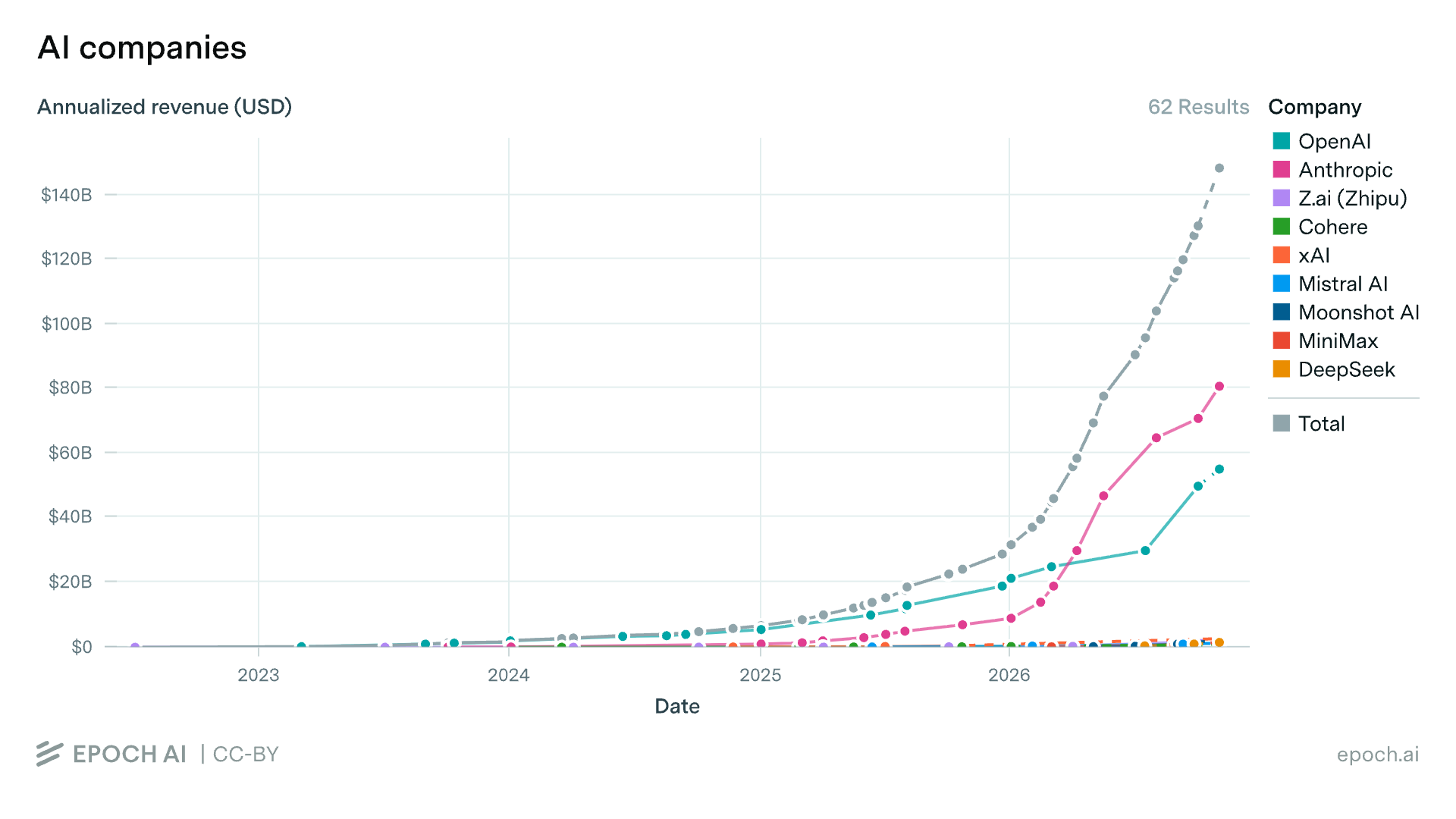
If revenue keeps growing six times a year, it will reach $10 trillion in two and a half years (March 2029).2 If it continues to accelerate, it could get there even sooner. The real world impact would come gradually, then all at once.
Growth could slow because of regulation or chip shortages (and it seems to have slowed a little in the last 1-2 months). But there are also reasons to expect increasing returns and further acceleration (which I’ve written about elsewhere). And as AI gets better, it becomes easier to deploy, unlocking faster growth.
2. Time horizons
My second favourite measure is the “time horizon”, developed by the non-profit METR, an independent AI capabilities evaluator. They have a benchmark of AI engineering, cybersecurity and computer-use tasks. For each task they measure how long it takes a human expert who’s new to it. Then they find the longest tasks each AI model can do.
As of April 2026, the best models could do tasks that take an expert three hours, succeeding 80% of the time.
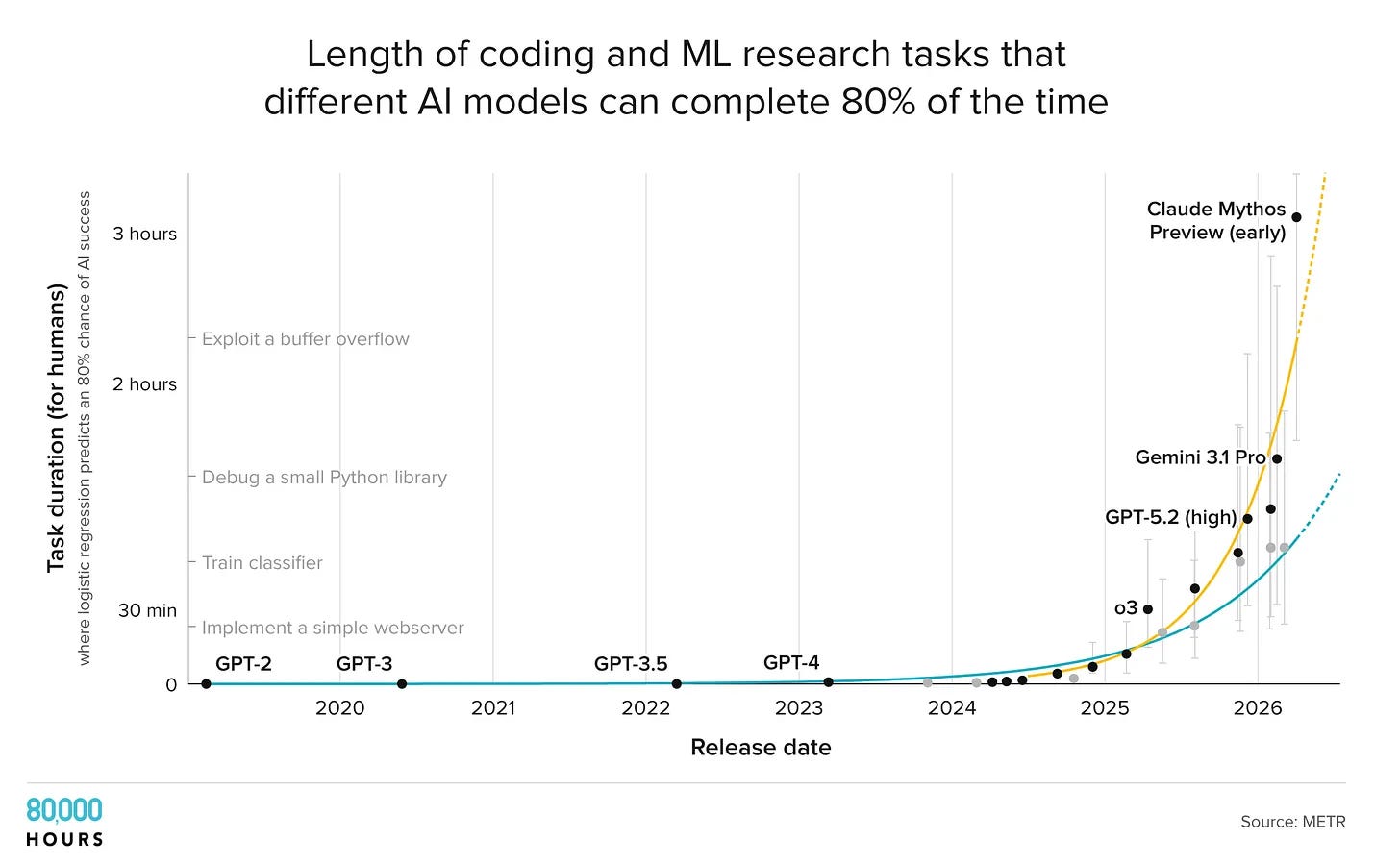
This trend has already sped up at least once:
From 2019-2023 it grew about three times every year
From 2024-2025 it grew eight times every year
And last week we learned that during 2026, the rate of progress has roughly doubled again. That would mean that over 2026, time horizons have been growing around 50 times a year.3
Unfortunately this is already beyond METR’s ability to measure directly. But we can infer it from AECI, a composite of Anthropic’s internal benchmarks.
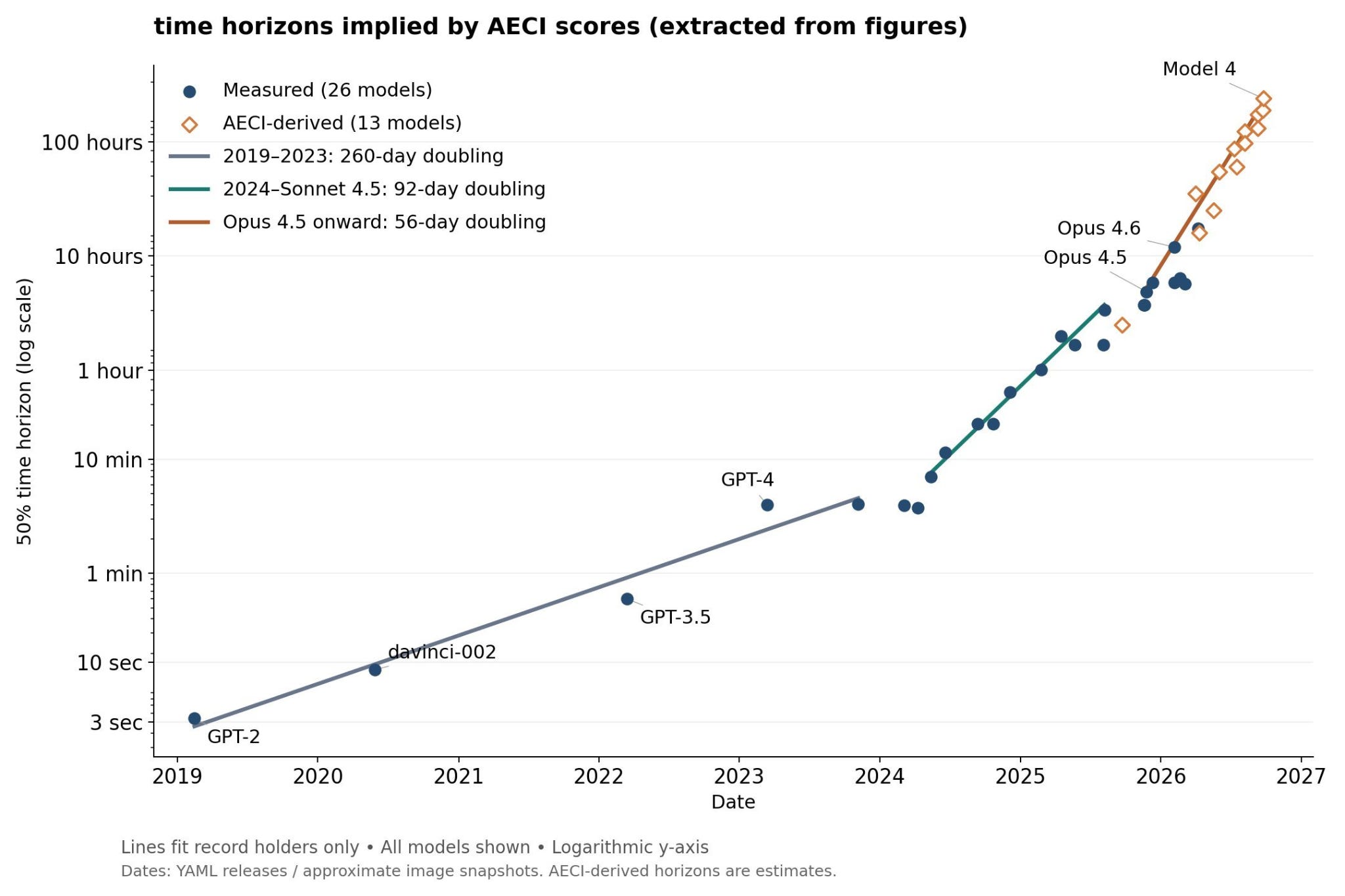
This graph has a log axis, which turns an exponential line into a straight one, so it shows a series of three exponentials, each faster than the one before.4 Putting it back on a linear axis would look like this:
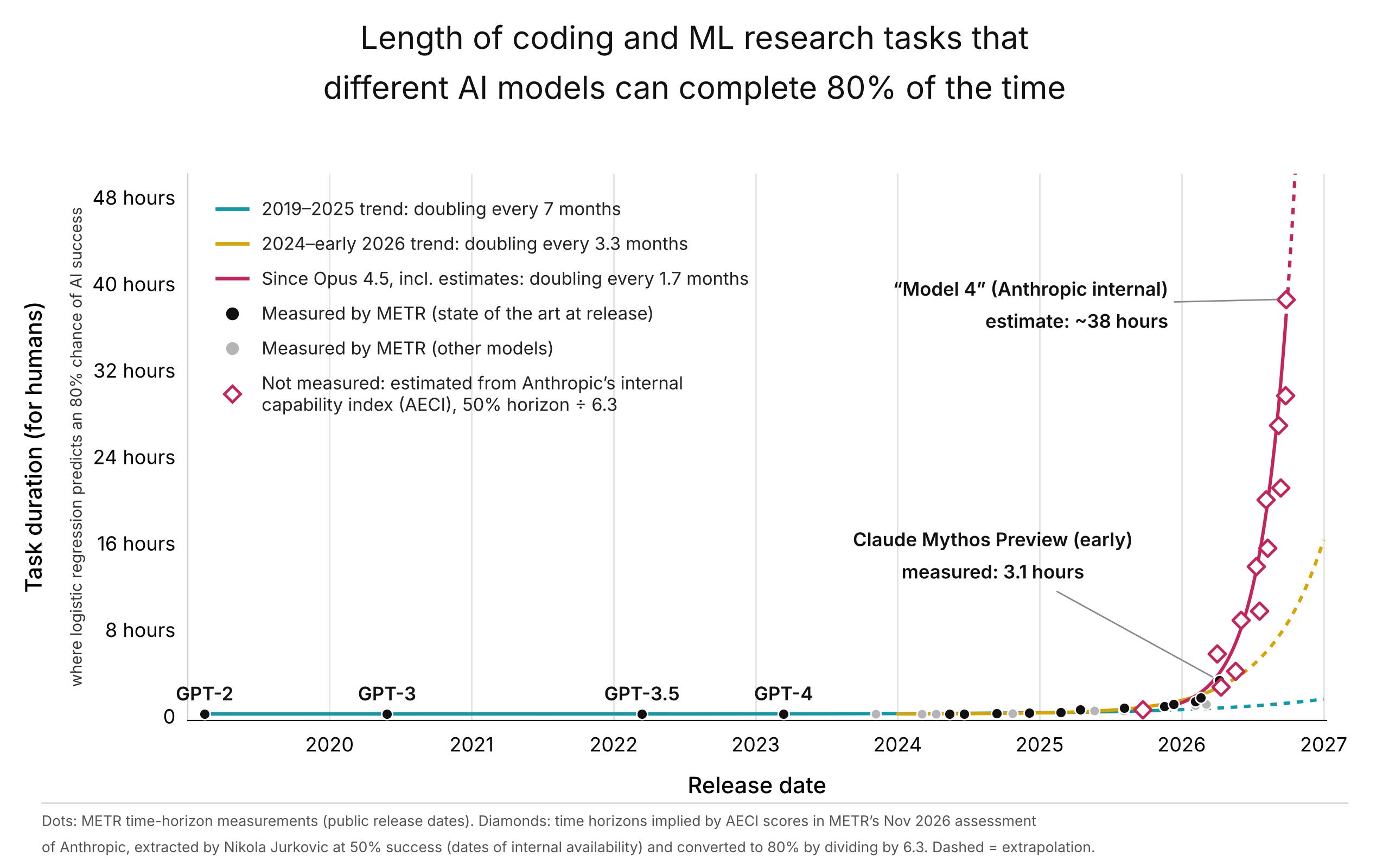
These three eras roughly correspond to LLMs, reasoning models and coding agents. And before that, there was a ~9 year era where deep learning was just getting started. In each era, capabilities improve faster than in the last. And each new era arrives in about half the time.
And these trends don’t just apply to coding, cyber and ML research. We see rapid progress on pretty much every benchmark.
Here’s Epoch’s Capabilities Index, which combines around 50 benchmarks into a single score. It shows a similar acceleration at the frontier. And many of these benchmarks reflect real world work.
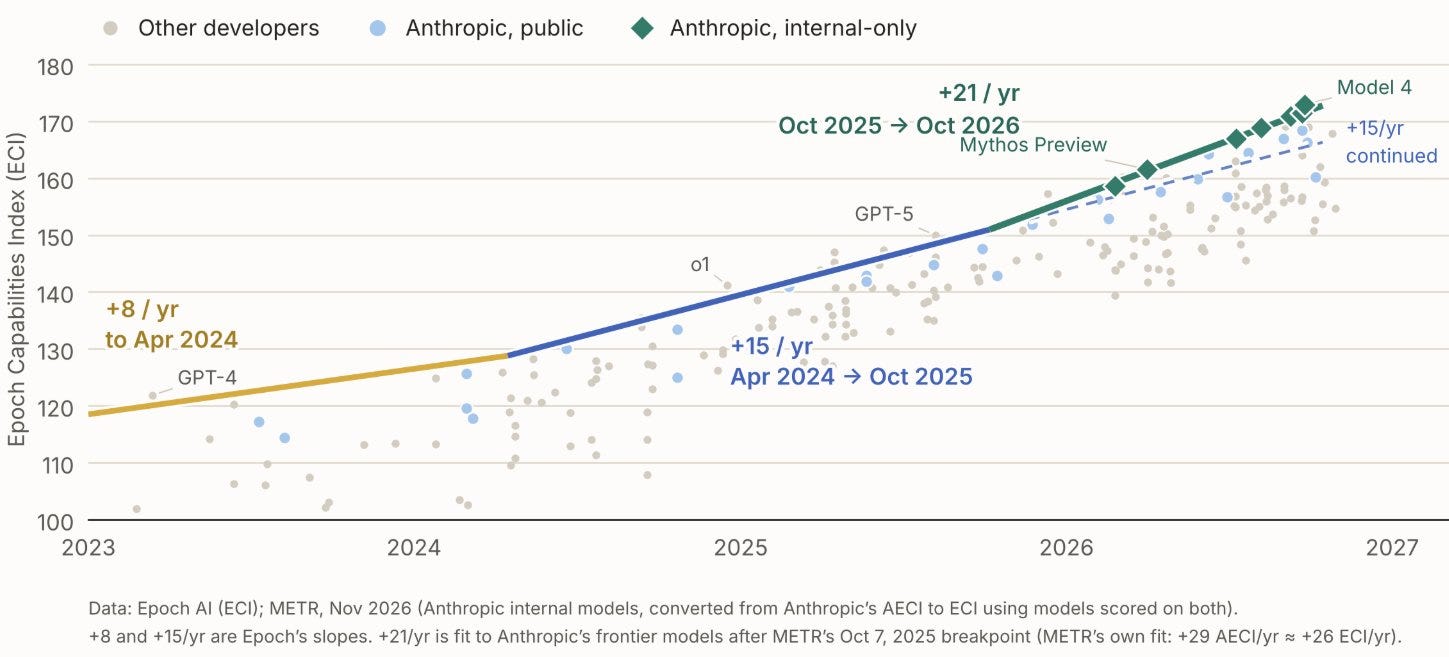
Convert that into time horizons, and it looks roughly like this.
In early 2023, AI could do difficult ten-second tasks (and more typical 30-second ones).
By early 2025, five-minute tasks.
By early 2026, hour-long ones.
Today, it can do difficult ten-hour tasks, and often over 100h.
Extrapolating the post-2024 trend forward gets us to one-week tasks in early 2028, and multiyear tasks in early 2030.
Extrapolating the post-2026 trend gets us to multiyear tasks in two years. If it keeps accelerating, we get there in about a year.
AI that can do a wide range of tasks that would typically take a human expert a year seems basically AGI.
In some areas, AI is already well ahead of these trends. In September 2026, OpenAI claimed their best internal model had solved over 100 important open maths problems, many of which had eluded top human mathematicians for decades, plunging some of them into existential crisis. A few weeks later, they made surprising discoveries in particle physics and computer science.
These tasks would have taken top human experts perhaps thousands or tens of thousands of hours of work, if they could have solved them at all. This seems to be explained by maths being both one or two years ahead of other tasks and also advancing on a faster trend.5
In other areas, AI lags behind. As of September, it still often can’t do multistep computer use tasks that would take a human expert an hour, like working through a video editing tutorial. That puts it about a year behind on computer use.
These gaps, plus the fact that most jobs aren’t just a list of hour-long tasks, explain why we didn’t see mass automation even in 2026.
But as far as I can see, the rate of improvement is similar in every domain we can measure, and probably across the board.6
This rate of progress is so rapid that even if there are important gaps, they probably get filled in one to three years later.
And the rate of progress seems set to accelerate further.
3. Recursive self-improvement
AI might now be starting to automate its own research and development. People have anticipated this since the dawn of computer science. Now it seems to actually be happening.
Earlier this year, with each new model, Anthropic researchers said in informal internal surveys that AI was making them 2x, then 4x, then 12x more productive.
In its pre-IPO report, Anthropic said it thinks the rate of AI progress has already accelerated about 2x in 2026.
I, and many other forecasters I trust, thought they were probably overestimating the effect. But METR has now independently evaluated their internal data, and basically agrees they were right.
METR thinks Anthropic’s progress has accelerated about 1.9x since October 2025 (roughly when coding agents started working well), and that by now about 80% of this comes from using AI to speed up their own research.
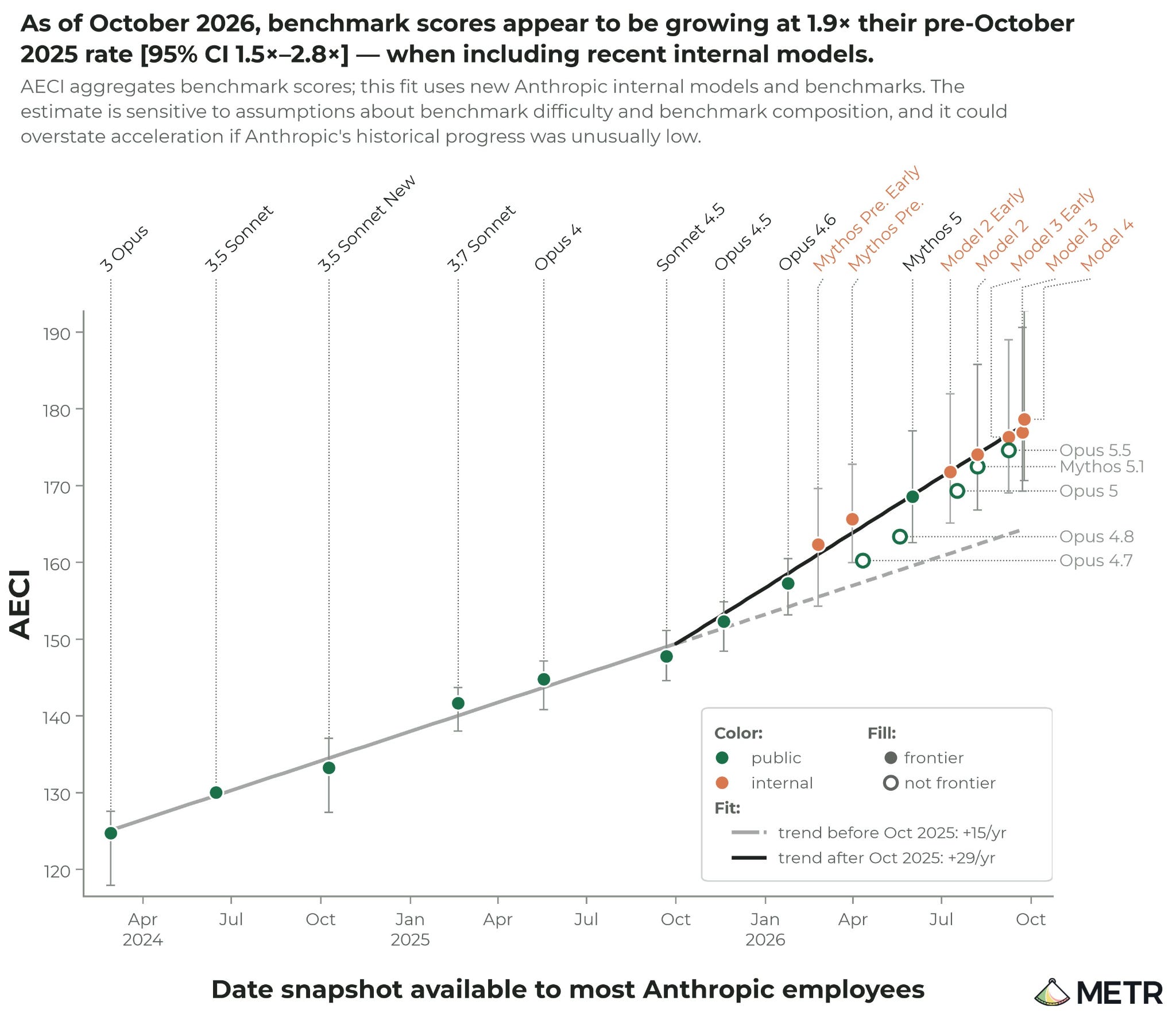
You can also replicate this finding with public data, though METR say much of the most convincing data has been redacted.
And if AI is now progressing 2x faster, the tools AI researchers use improve faster too, which speeds them up even more.
In a very simple model, each doubling in the pace of AI progress takes half as long as the last: 12 months, then 6, then 3, then 1.5.
Several more sophisticated takeoff models from the AI Futures Project give a similar acceleration into the end of 2027.
This lines up with what many inside the AI companies say they expect to happen. For example, see this recent note by Jack Clark at Anthropic, who said full recursive self-improvement could become possible in 2027.
It also lines up with data Anthropic and OpenAI both recently published on how much they’re using AI to do AI R&D. For example, by August Claude was leading 26% of model R&D efforts, up from 0% in January.
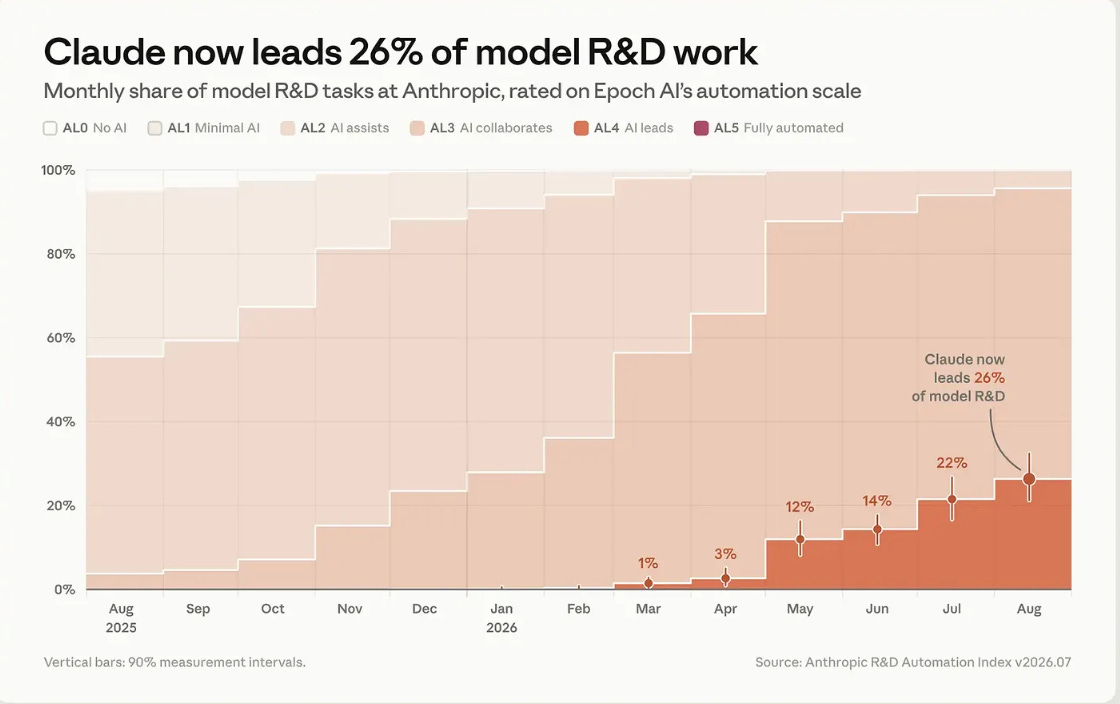
Extrapolating that gets you to Claude leading almost all R&D in mid-2027:
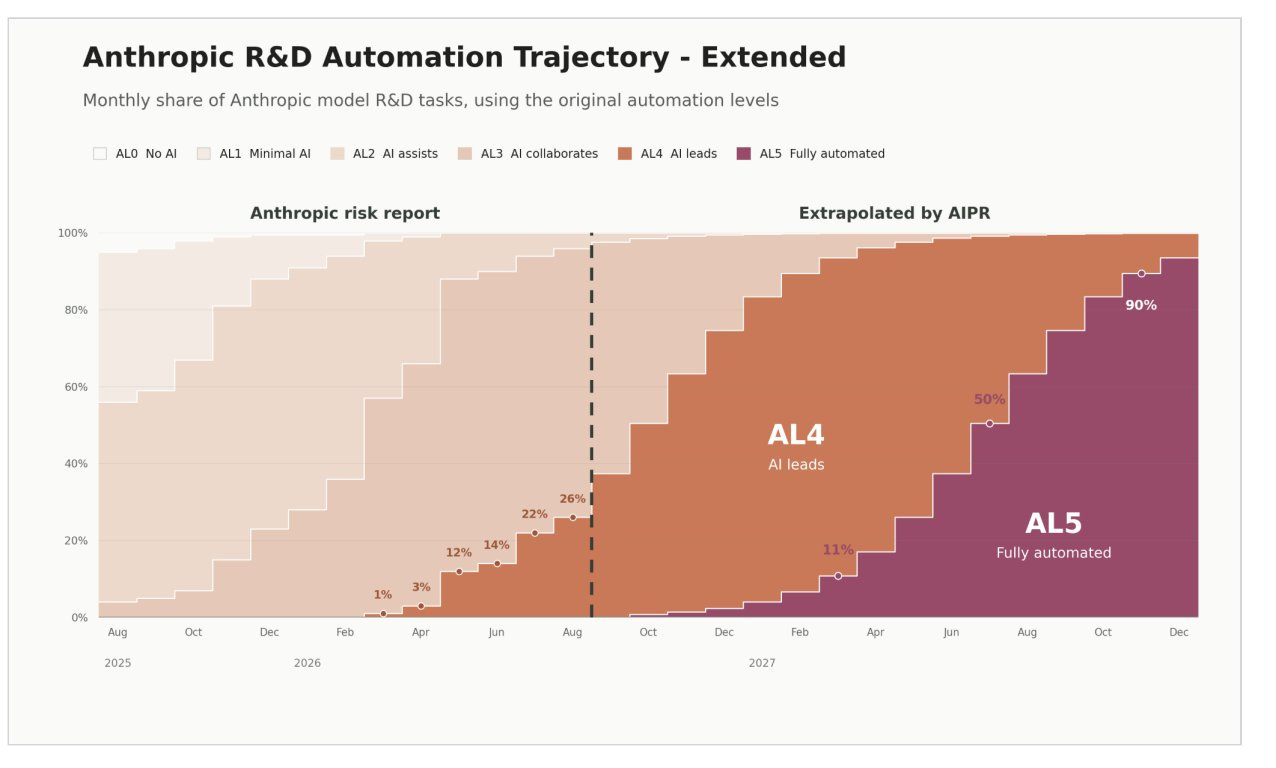
And as we saw, by mid-2027, we should have systems that can do multimonth ML engineering tasks with 80% reliability, which many think will be enough for significant automation.7
What would automating AI R&D actually mean? You don’t get infinite progress overnight. AI research already faces significant diminishing returns, which will eventually get much stronger and hit fundamental limits.
But those limits could be well beyond the human level. Most AI researchers (and METR) can still see many avenues for algorithmic progress. Experiments also take time to run. More careful attempts to model what happens suggest we’d get something like four years of progress in six months. It’s possible there’d be no acceleration at all, but I think an acceleration is more likely than not.
Four years of progress might not sound like much, but it’s about the size of the jump from GPT-4 to GPT-6.
We forget now that GPT-4 would regularly fail at simple maths questions, and couldn’t do any agentic tasks on a computer. GPT-6 can make novel mathematical breakthroughs, outperform human experts on basically any well-defined written task, and pull off complex autonomous cyber attacks.
If recursive self-improvement gets going it could look like reaching GPT-7 in April 2027, GPT-8 in Sept, GPT-9 in Nov and GPT-10 in December.
That would probably mean a leading AI company (with 10% of global compute) could run the equivalent of:
A hundred million agents thinking at 50x human speed.
Each better than the top human expert at almost any cognitive task that can be done remotely, from scientific research to strategy, marketing and financial trading
Coordinating superhumanly with nearly perfect focus on any shared goals
Supported by trillions of streamlined agents carrying out specialised tasks (like hacking, piloting drone swarms, or generating scientific hypotheses)
And not long later, efficiency gains would mean just 0.1% of global compute would be enough to run all these agents.
If these systems don’t share our goals, it’s difficult to see how we could remain in control of them.
Will the trends continue?
Most concrete candidates for limits to progress, like a lack of continual learning or real-world data, look solvable in years rather than decades.
Trying to identify the specific bottlenecks has a terrible track record, since they tend to get blown past within a year or two. So I prefer to look at the underlying trend.
The fundamental drivers of AI progress are more computing power and more people working on research. For over a decade, across a more than ten-billion-fold increase in computing power, more compute has reliably meant more capable AI.8
As far as I can tell, the path is clear for computing power and research labour to keep growing at recent rates until 2028 (in fact, many of the investments have already been made).
After 2028, bottlenecks like building lithography machines may start to slow the trend. But they won’t stop it.9 Without a pause, and without recursive self-improvement, I think our base case should be at least two more years of rapid progress, perhaps followed by another four years at about half the speed.
But algorithmic recursive self-improvement doesn’t need any more chips. If it happens (and AI isn’t deliberately paused), we should expect progress to keep accelerating from here.
It now looks like a strong algorithmic-only feedback loop will be reached before growth in compute slows down.
Another possibility is that the trends continue, but some important kinds of tasks stay out of reach and prevent explosive change. These might be tasks that are hard to verify, or that need lots of context, data and continual learning.
Personally I think at current rates of progress these tasks are just several years behind, and recursive self-improvement could easily lead to algorithmic breakthroughs that overcome them. But it’s a hard question, and one I hope to write more about (see footnote 6 for more).
So when will we get AGI, and what does it mean?
Unless deliberately paused, my best guess is the trends continue for the next 2-4 years, bringing us to digital worker AGI before 2030. But I think there’s a significant chance (30%+) that recursive self-improvement has already started, and brings us to broadly beyond-human AGI in just 6-18 months.
I could be fundamentally confused, there could still be important bottlenecks, many people disagree with me, and AI could be deliberately paused. So I still think there’s a ~25% chance it happens later in the 2030s, and perhaps a 20% chance it takes decades.
Many also point out that AI that can only do remote work won’t necessarily cause explosive change or loss of control immediately. It would take time to deploy robots needed to automate many real world tasks, or to gather enough data to learn how to do every real job.
I think hundreds of millions of superhuman AIs, even purely virtual ones, would already be pretty crazy, and already pose a takeover risk. At worst, they’d just need to bide their time a few more years.
More importantly, the world is already rushing to scale robotics, and with AGI’s help, full deployment may only take another 3-5 years, and could be much faster. Explosive change just a couple of years later is not particularly comforting.
What should we make of this? I find it hard to internalise, and feel confused about what to do. Denial, fear and grief are natural. Even in the positive scenarios, the world could quickly become alien to us.
In my higher moments, I can sometimes find some appreciation for being alive at one of the most interesting moments in history. Then I try to focus on what I can do about it, both personally, and to help it go well for society.
That means asking what’s most urgent to get done before better-than-human AI arrives. And putting off anything that can wait, non-urgent priorities AI might be able to do better than me in a couple of years.
As for helping it go well, I think the most useful thing we can do is to slow it down, globally. Stretching the arrival of beyond-human AI from two years to ten would give us far more time to adapt, decentralise power, and decrease alignment risks. But we also need to prepare for a world where the AI race continues, and make it safer at the margin.
That said, the possibility of superintelligence by 2028 doesn’t mean you should drop everything that takes longer than two years to pay off. It could also arrive after 2030, and if algorithmic-only recursive self-improvement isn’t possible, the takeoff will be slower. So if you’re a student, or could become ten times more impactful five years from now, betting on helping in the 2030s can make sense.
But the forces of inertia are massive. It’s extremely difficult to act on an abstract scenario until it hits you in the face. So most people aren’t planning for, let alone acting on, the possibility of near-term superhuman AI. Odds are, you’re also one of them.
If you can, set aside a weekend to reflect on what’s happening and what it means for you. Here are some starting points.
I hope to write more on my Substack as I learn more in the coming months.
This is a rough US figure. Wages and salaries are about 42% of US national income, or 50% including benefits (Tax Foundation, from Bureau of Economic Analysis data). In the Bureau of Labor Statistics’ May 2025 occupational data, white-collar occupation groups (management, business and finance, computing, engineering, science, law, education, media, healthcare practitioners, community services, sales and office support) make up about 56% of jobs. They pay more than average, so they earn roughly two-thirds of all wages. Two-thirds of 42% is about 28% of GDP, or about 33% counting benefits. The share is lower in poorer countries, so the global figure is probably somewhat below 30%.
Extrapolation of growth in company market value (rather than revenue) also arrives at a similar place.
The data also lines up 2-month doubling times in data released by OpenAI and Google for time horizons in real-world AI R&D tasks (which would represent about a doubling compared to a year ago).
Arguably it would be better to look at a log-log plot of AECI and time horizons, but this produces a similar result.
Post-2024 math horizons seem to have been increasing 10-100x per year. Starting from 3-hours in July 2025 (when AI could do multihour International Math Olympiad problems), and adding a 2x acceleration in 2026 (which means horizons increase 100-1000x per year), gets you to decade long tasks around now.
We should expect it to take longer for AI to crack tasks that are data-poor, high-context or difficult-to-verify, but the same methods can still work.
If AI were failing to make progress at all on these kinds of tasks, then the messier and more realistic the task, the slower progress should be. Instead, METR find time horizons are increasing at similar rates across every domains. They also find messier tasks within benchmarks are improving just as fast as the cleaner ones. Other benchmarks of more messy realistic tasks (like GDPval or the Remote Labour Index and real world AI R&D tasks) also show rapid improvement (2-3 month doubling times). And AI’s application in judgement-laden domains like law and financial modelling and writing fiction books is growing rapidly. It’s also able to do things like coordinate complex real world cyberattacks.
Our measurements are not great, so it’s still possible the rate of progress is slower on these other tasks, which could significantly delay timelines. However, another confounder is that the AI companies decided to especially focus on coding agents, since that was the best route to near-term revenue. Once that’s saturated they’ll start to more deliberately optimise for other jobs. Algorithmic advances in in-context learning could also quickly unlock difficult-to-verify tasks.
Maybe there are some ineffable skills that benchmarks can’t capture, and are also not improving (and wouldn’t be improved if the AI community decided they were the main bottleneck). But I wouldn’t bet on it. On vibes the models also feel much better at softer skills / judgement / strategy / theory of mind etc. than they were a year or two ago.
METR did find a slower rate of progress in Tesla’s self-driving dataset. This is evidence that progress on physical tasks is indeed slower than virtual ones. More broadly, we lack good robotics benchmarks so it’s hard to know. On the other hand, progress on robotics seems faster than expected, and I would not be surprised to see effective general-purpose robotics by 2030.
Today OpenAI’s best internal models can do real ML research tasks that take 15 minutes, putting it only about one year behind METR. So once METR has reached 1-month, you might be at 20-hours on these tasks.
More specifically, computing power and research labour can be used to do more pretraining, more reinforcement learning, to design better agent scaffolds, and to come up with new algorithmic advances. These all continue to yield gains.
They also all face diminishing returns, but that was already true over the last four years. The question is whether the inputs can grow faster than the returns diminish.
And if trillions of dollars are riding on the production of more lithography machines, people may find a way to produce them faster.
Benjamin, I can grant you all three trends and still see no reason, on the strength of those trends, to expect broadly superhuman AI in 18 months.
First, revenue. You estimate what companies might pay if AI could do most office work, then treat that level of spending as evidence that AI can do most office work. The inference only works in one direction. A hundred million people might each pay for help with one part of their job and spend the rest of the day doing things the software still cannot do. Every buyer could be perfectly rational. That is quite a lot of cognitive science to ask of a sales figure.
Second, task horizons. A system that solves a problem that would take an expert three weeks has achieved something impressive. But who chose the problem, decided which assumptions were reasonable, and specified what would count as a solution? As a teacher, I could make a maths problem considerably harder while leaving the most important decision to myself simply by telling the class which method to use. Three weeks of work inside a given frame tells me remarkably little about who can recognise when the frame itself is wrong.
Third, recursive self-improvement. Researchers using AI to build better AI faster is a genuine feedback loop. The question is how much of the research judgment still comes from the researchers. If they identify the weakness, choose the experiment and decide whether the result counts as progress, then measuring how much faster the team works does not tell us when the model will be able to take over those decisions. Yet your forecast depends on precisely that distinction.
That leaves three problems your argument never addresses. The semantic problem: how does the system establish that an intermediate result means what it is supposed to mean? Two sign errors can give the right final answer. Reuse either intermediate value elsewhere and the error is back. The frame problem: what prompts the system to question the assumptions of a task when every success criterion it has been given rewards staying inside those assumptions? The safety problem: once an agent can modify parts of the system that evaluates it, how do we independently establish that a better score reflects a genuine improvement and that the checks themselves still work?
I would therefore leave the burden of proof where it started. I owe you no explanation for why progress will stop. My objection works just as well if revenue keeps rising, task horizons keep lengthening and AI labs keep getting faster. What you owe the reader is a reason to expect those trends to carry us across the gaps above. Eighteen months is a strikingly precise number for an argument that leaves the crossing unexplained.
"More importantly, the world is already rushing to scale robotics, and with AGI’s help, full deployment may only take another 3-5 years, and could be much faster. Explosive change just a couple of years later is not particularly comforting."
No this is not true. Happy to go into it more deeply as I digged into this for weeks. How quickly after ASI could you build an industrial state the size of let's say China? It's probably at least 14 years, but most of the probability mass has to be put on 25+ years
Your WW2 scenario lacks a lot of detail, things have changed between now and then. The Epoch models are alsojust unaware of how supply chains actually function, where they are, as well as are able to scale or not scale at what timeframes even with infinite labor in the world. Again, happy to go into it.